Showing posts with label nanni moretti. Show all posts

Friday, February 01, 2008

Caos Calmo


I am very excited to see that Nanni Moretti's latest film, Caos Calmo (Quiet Chaos), is due to be released. It may take awhile for a subtitled version to make it to market, but I'm thrilled nonetheless. This story is based on Sandro Veronesi's novel about a successful manager who tries to help his 10-year-old daughter cope with her mother's death.

Friday, December 28, 2007

Lost in absurdity

In my previous life, before Ian, I often used to blog about my favorite filmmaker, Nanni Moretti. (You can click on the "Moretti" label at the bottom of this post to see all my previous entries on him). I own almost all his films, and still want to organize a Moretti film festival here in Minneapolis.

One of the things that I love most about his films is how he captures those feelings of being lost in a world that often appears quite absurd. He does so with wit and playfulness. Here are a few clips:

Palombella Rossa - The Pool
Palombella Rossa - The Car
Caro Diario - The Cafe

Tuesday, August 21, 2007

Moretti's best (thus far)

I've received and watched Il Caimano, Moretti's latest. Not his best work, but entertaining and thought-provoking. My favorite Nanni Moretti films, in this order:
  1. Caro Diario - A classic. Shot in three "chapters," this film is probably my all-time favorite film. There are so many quiet - and funny - moments as Moretti playfully cruises around Rome on his Vespa, looks for a tranquil spot to write his script, and deals with the frustration of illness.
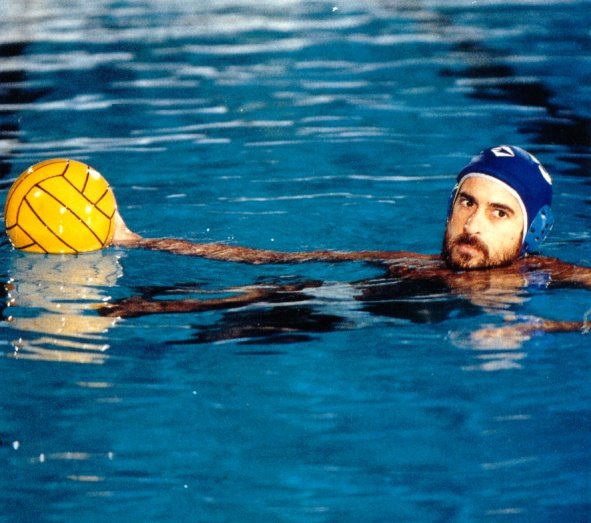
  2. Palombella Rossa - Hard to find but well worth it. Moretti is a middle-aged water polo player who has lost his memory. A metaphor for the radical political change in Italy, it's about adapting to an ever-changing world.
  3. Aprile - Moretti stars as a film director who doesn't want to grow up, and he's having a son. Filmed over 4 years, it captures many small moments that make up a well-lived life.
  4. The Son's Room - A heartbreaking drama about dealing with the loss of a child. Moretti's most serious role, and one of his best. I would put this higher in my rankings, but it's a difficult film to watch, whereas his previous films can be watched multiple times.
  5. Il Caimano - A drama that examines the rise of the past Italian Prime Minister, Silvio Berlusconi. But it's more than that. It's also a drama about a family falling apart. There were tender parts, and some funny ones, but I'll have to watch it again to see what I missed. It helps to read up on the last few years of politics in Italy to get some of the references.
I currently have La Seconda Volta on order, a film produced by Moretti's film company and starring him as well.

Monday, August 13, 2007

Nanni Moretti on making films

"The hardest time for me is writing, the most tiring is when I shoot. When I finally get there, I feel free."
Nanni Moretti

Wednesday, August 01, 2007

The Cayman


I am very excited as I've finally found a copy of Nanni Moretti's latest film, Il Caimano, with English subtitles. (The last copy, at that.) It's taken nearly a year, but I guess they've finally found US distribution. No doubt it was a hard sell being that there's not much of a draw for Italian political stories here.

I can't wait.

Wednesday, July 18, 2007

The end of First Friday Films

The co-founder of First Friday Films, John, has moved back to the east coast to pursue work with The Discovery Channel and to get his non-profit organization - Media Serve International - up and running. He asked me if I wanted to continue showing documentary films at Bethlehem Baptist, but after thinking it over, I've decided not to any more. Besides having to work on my philosophy series, I'm just not cut out for the "culture" of the Church. I enjoy talking about films and diverse issues, but perhaps there is another venue.

I still want to have a Nanni Moretti marathon film showing: Palombella Rossa, Aprile, Caro Diario and The Son's Room, in that order.

Friday, March 09, 2007

Friday, April 21, 2006

I hated, hated this movie

I hated the Italian film, Padre Padrone. I detested it. If only I could find all the copies of this miserable film and throw them into the depths of the Mariana Trench. I only watched it two nights ago because it was the first role for Moretti in a major film (1977). Maybe it was the extended scene of three boys having sex with chickens. No, I believe it was when one of them had sex with a mule. Or maybe the scene when a boy severely beats a sheep before having sex with it.

But I watched every vile minute of it. It won at Cannes in the 70's, after all. I hope the director gets a paper cut.

Thursday, April 20, 2006

Wednesday, April 19, 2006

Grown up films

I came across a review of Nanni Moretti's, Aprile, about an anxiety-plagued director who isn't sure how, or even whether, to finish his films:

"...the self-doubting director in Aprile (played by Moretti himself) is so lazy (emphasis mine) and haphazard that the film is less a serious probing of the creative process than a comical, light-hearted testament to the virtues of procrastination."

In the film, Moretti awaits the birth of his son. He is torn between making a "grown-up" documentary about the political situation in Italy or making the film he really wants to make, a whimsical musical. He begins shooting his musical, then quits to make the documentary, then... back to the musical.

The reviewer seems to have missed the entire point of the movie. Moretti's character's indecision springs from the impending birth of a child who will require Moretti to become an adult, to "grow up." His "procrastination" is a sign of his inner struggle, of having to leave the light-hearted world of musicals to the responsible world of real films, important films. In the end, Moretti refuses to "grow up," and returns to his passion.

I was glad that Moretti's character returned to his passion at the end of the movie. The world has far too many "grown up" filmmakers making "serious" films. Moretti's character could have made political documentaries - and would have been completely miserable doing it. How does the quote go? Something like, "God's glory is a man fully alive." Along those lines.

By following his passion, Moretti's character was indeed a "grown up." He listened to his inner song and let it take form. I, for one, am tired of grown ups. I am surrounded by them.

I hope Moretti never grows up.

Monday, April 17, 2006

Money and Power

While eating an excellent turkey bagel sandwich on this gorgeous afternoon, I reread the first chapter of Jacques Ellul's book Money and Power. You can read the whole book online here. (I listed this book in a previous blog as having impacted me many years ago.) Ellul is sometimes called a "Christian anarchist," and his thought is highly influenced by Marx.

Moretti? Ellul? Am I becoming a socialist in my old age?

"When we open the Bible we do not find a philosophy, a political statement, a metaphysic or even a religion. We find instead the promise of dialog, a personal word addressed to me, asking me what I am doing, hoping, fearing‑and especially what I am."

"The texts (Scriptures) are therefore never a "solution." To the contrary, they get us started on a journey, and the only answer we can hope to find is the one we ourselves give by our lives as we proceed on that journey."

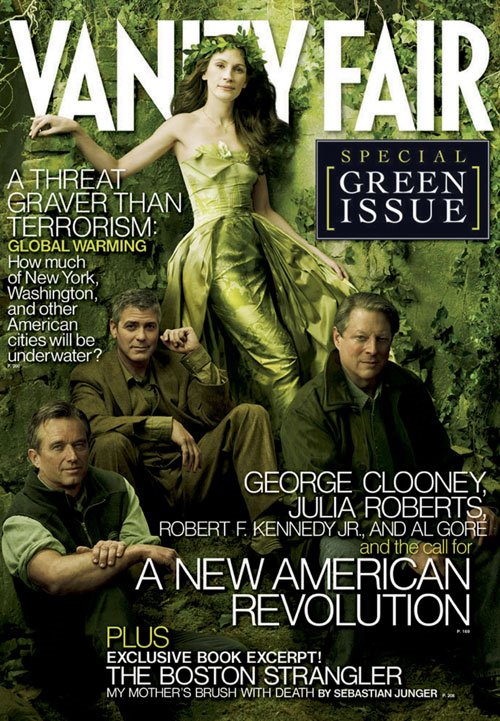
The Green Issue

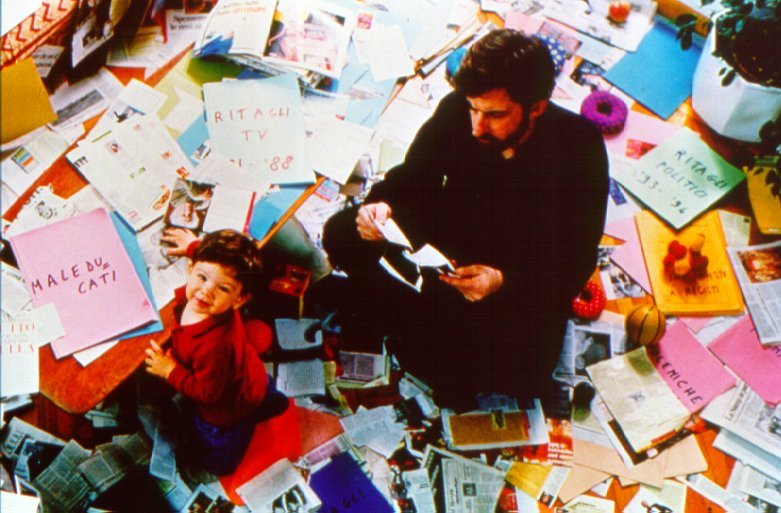
There's a scene in Moretti's film, Aprile, where he and his young son sit in a pile of letters he never mailed to the leaders of his political party. At the end of the film, he rides through the streets of Rome on his Vespa, throwing the letters into the wind.

This month's issue of Vanity Fair, The Green Issue, is causing me to write yet another "letter", one of those "letters" that clutter the mind yet never get put to ink.

My "letters" are always composed to the same group of people. Those who, in my youth and early adulthood, so greatly influenced my perception of God and the way He interacts with the world. As I began reading one of the environmental articles in Vanity Fair, I started to compose a rather angry "letter" to an old co-worker, one who supports these views of the environment.

I think I need to rent a Vespa and take a ride around one of the lakes tonight.

Friday, April 14, 2006

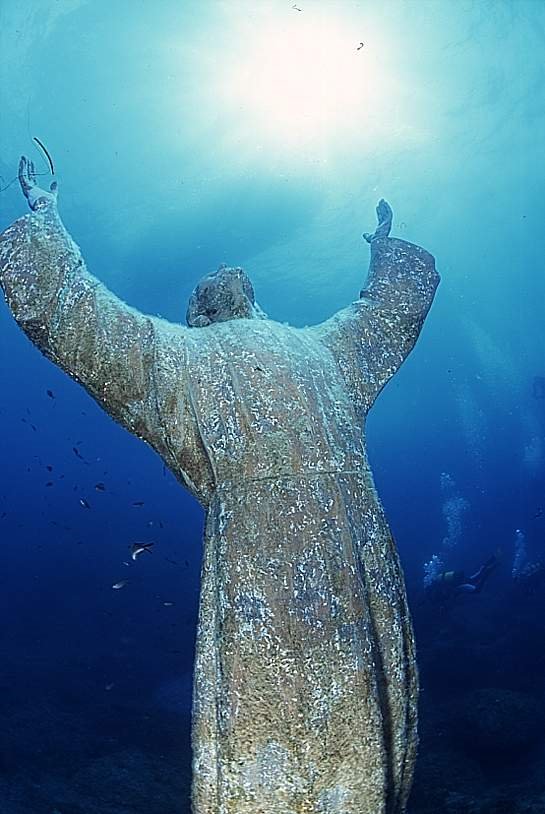
Cristo degli Abissi

(click picture to enlarge)
Christ of the Abyss

[Updated] I was just sitting here, thinking about why this picture appeals to me. I posted it about an hour ago. It's Good Friday, so I felt compelled to post something to do with the occasion. I nearly posted this picture (too... artsy), then I nearly posted this picture. (from a place Annie and I visited in Lisbon... not quite right)

There is a feeling when you're diving, the weightlessness, the otherworldness, the... helplessness. When you're thirty to forty feet under water, you are at a threshold, a crossroads. Any deeper, and you begin to lose the light and your dive-time decreases. At fifty feet and deeper, your risk of the bends increases. Moving into shallow water brings more safety, yet many of the most beautiful sights lie in deeper water.

Cristo degli Abissi lies in 50-feet of water.

I guess I thought this picture was a great metaphor for my relationship with Christ. He keeps calls me into the deeper water. Not really an original thought, but it's mine for the day.

(or maybe I just couldn't think of a way to tie Nanni Moretti to Easter.)

Thursday, April 13, 2006

Christians and Moretti?

Conservative film reviewers at Christian Spotlight endorse Moretti's 2002 The Son's Room. (while giving it a "somewhat offensive" moral rating.) Ultra-leftist Moretti and ultra-conservative film reviewers finding common ground? Has Moretti lost his edge?

"...it's too bad more believing Christian families don't seek out these kind of "art house" films instead of settling for the usual vulgar timewasters at the cineplex."

Monday, April 10, 2006

Something beautiful

I must film what brings me pleasure, not those ugly things. The designers show their collections in a museum of Florence... And because of that I must go film them?

Aprile

Commentary on Il Caimano

The best article on Il Caimano I've read so far; a great overview of the politics in Italy and the role of art. From Swans, an on-line publication.

Friday, April 07, 2006

Words


Who speaks badly, thinks badly and lives badly. We must do words justice: words are important!
Palombella Rossa

Thursday, April 06, 2006

You know what I was thinking?

You know what I was thinking? I was thinking how sad it is that I, even in a society more decent than this one, will always find myself in tune with the minority of people. But not in the sense of those films where there is a man and a woman who hate themselves, stranded on a desert island because the director does not believe in people. I believe in people, just not in the majority of people.
Caro Diario

Wednesday, April 05, 2006

David di Donatello Awards

"The nominations for Italy’s national film prizes, the David di Donatello Awards, were announced yesterday in Rome. Two films eclipsed most others with 13 nominations each: ‘Il Caimano’ (The Cayman) from Nanni Moretti, currently holding the top spot at the local box office, and Michele Placido’s ‘Romanzo Criminale’ (Crime Novel). Both were nominated in most categories, including ‘best film’, ‘best director’, ‘best script’, ‘best actor’ (for Silvio Orlando and Kim Rossi Stuart respectively), ‘best supporting actor’ (Nanni Moretti, Pierfrancesco Favino), ‘best cinematography’, ‘best music’, ‘best production design’, ‘best costume design’ and ‘best producers’."
(more...)

Dreams and Diaries II

This excellent review of 1994 Cannes winner, Caro Diario, captures what I had hoped The Cinema of Nanni Moretti: Dreams and Diaries would.

"Moretti's three-part movie-essay is structured as a wry, affectionate and very funny odyssey through the Roman suburbs, the Aeolian Isles, and the Italian health system. Relaxed and leisurely, it's an effortless blend of documentary and fiction, part road movie, part sociological satire, part polemical reminiscence. As Moretti travels around, investigating and commenting, he manages to provoke not only laughter, but the sense that we are seeing Italy anew. Accordingly, just as he includes offbeat gags about, say, movie critics being fed a taste of their own medicine, so when he drives to the site of Pasolini's murder, he forces us simply to look and listen, to take in light, space, shape, movement and music; in other words, to recognise the essence of cinema shorn of story and superfluous stylistic tropes. That's no mean achievement in these days of narrative and technological overkill, though the movie is too modest to insist even on its own quirkiness, let alone its more serious subtextual concerns."